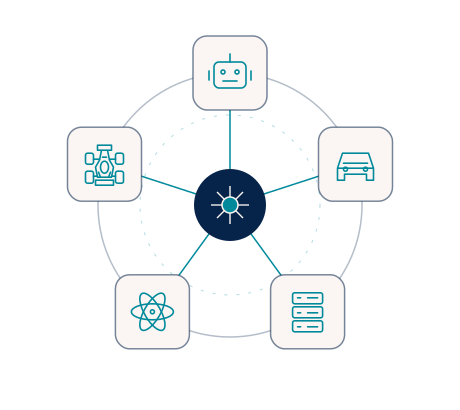
The following focus areas provide starting points for investigation. Each mandate defines the specific application, commercial objective and evidence required.

Robotics
Commercial pathways for embodied intelligence and automation.
Fractionova applies AI-driven Opportunity Intelligence to the relationship between robotic capability and the operating environment in which it must deliver value.
Areas of investigation include:
- Robotics in manufacturing and industrial automation.
- Autonomous systems and mobility applications.
- Service robots in healthcare, retail and hospitality.
- Warehousing, logistics and supply-chain intelligence.
The assessment connects customer requirements with integration complexity, deployment economics, service capability and the organisations influencing adoption.
AI-assisted analysis maps technology providers, integrators and potential customers, identifying which combinations merit direct qualification.
The commercial decision: Which application and delivery model offer a credible basis for deployment, and which relationships are required to establish it?
Read the perspectives on robotics

Mobility
Market position across vehicles, infrastructure and emerging transport systems.
Fractionova investigates the commercial configurations connecting mobility technologies with customer demand, infrastructure and operating requirements.
Areas of investigation include:
- Electric vehicles and EV infrastructure.
- Autonomous vehicles and robotaxis.
- Micromobility and urban transport solutions.
- Urban air mobility and eVTOL services.
- Enabling components, powertrains and energy systems.
Its AI engine compares market conditions, technology dependencies, partner capabilities and potential entry structures. Analysis connects the product proposition with the infrastructure, support and local participation needed to serve the intended application.
The assessment can extend to sourcing, manufacturing partnerships, technology licensing and localisation, with investment decisions linked to evidence of demand and readiness.
The commercial decision: Where can the business establish a viable position, through which operating model, and with what sequence of commitments?
Read the perspectives on mobility

Data Centres & Intelligent Infrastructure
Commercial participation in the infrastructure supporting AI and data-intensive computing.
Fractionova examines where equipment, technology and specialist capabilities can fit within a defined infrastructure project or supply ecosystem.
Areas of investigation include:
- Hyperscale data-centre infrastructure.
- AI and high-performance computing.
- Advanced cooling technologies.
- Data-centre power and energy systems.
AI-driven investigation connects project signals with procurement structures, technical requirements, integration responsibilities and service expectations.
The analysis distinguishes prospective demand from an accessible commercial opportunity. It examines who specifies, purchases, integrates and supports the offering, and how each relationship affects the supplier’s position.
The commercial decision: Which project, partner and delivery configuration can support a credible first deployment and subsequent expansion?
Explore the Data-Centre Cooling Assessment
Read the perspectives on data centres

Quantum Innovation
Strategic intelligence at the frontier of commercial readiness.
Fractionova treats quantum innovation as a monitored frontier for focused assessment, examining the relationship between technical progress, application requirements and commercial participation.
Areas of investigation include:
- Quantum computing hardware and systems.
- Quantum software, algorithms and development platforms.
- Quantum cryptography and secure communications.
- Quantum sensing and precision measurement.
- Quantum networking and photonics infrastructure.
AI-assisted investigation connects technical evidence, development milestones, prospective applications and ecosystem participants. Specialist input is scoped around the technical questions material to the decision.
The assessment distinguishes grounds for near-term engagement from developments that warrant continued monitoring.
The commercial decision: Which application, collaboration or enabling capability merits attention now, and what evidence would justify a greater commitment?